Big Bang Theory FAQs | Origins, Science & Mysteries

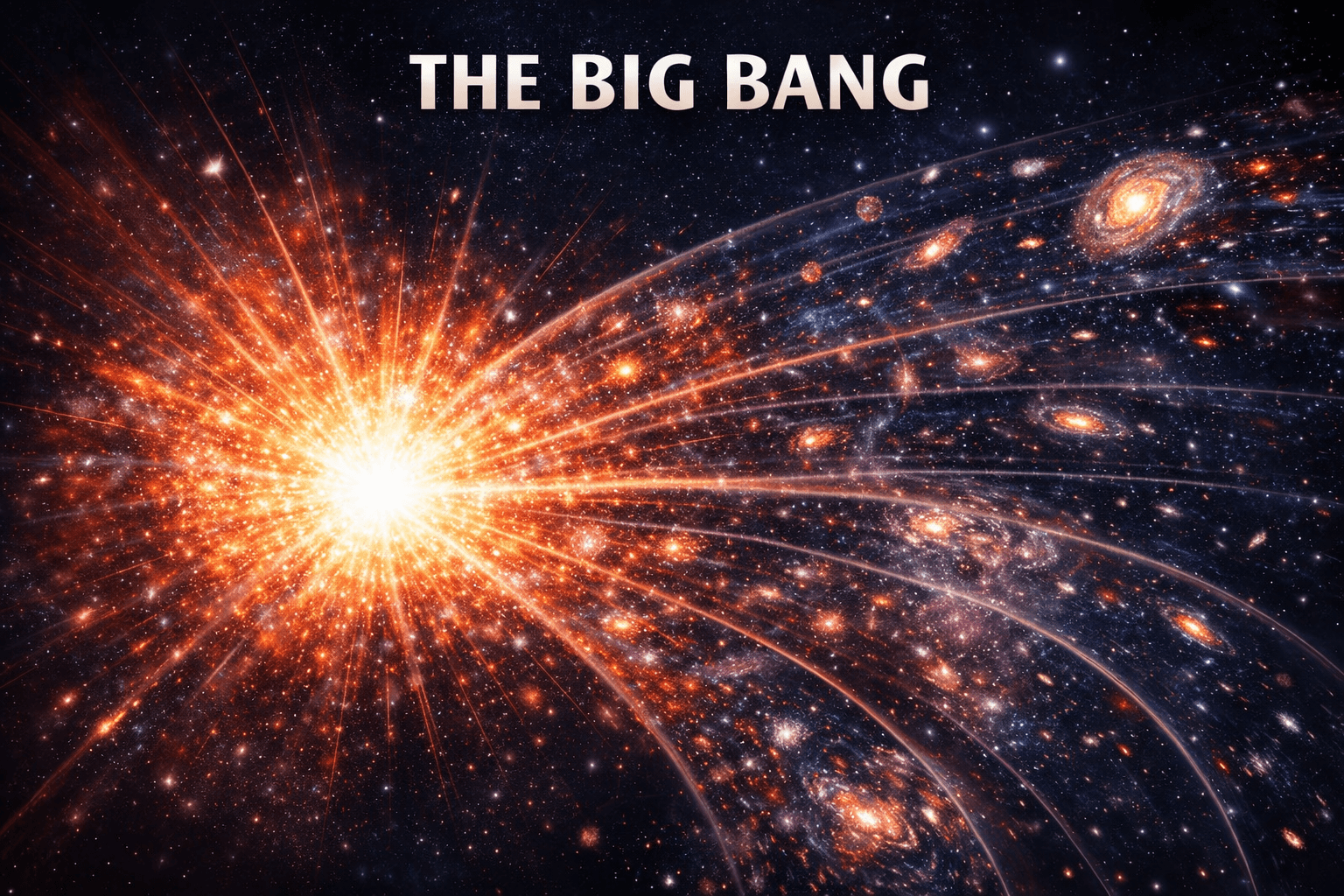
The Big Bang Theory is the leading scientific explanation for how the universe began and evolved into what we observe today. It sits at the intersection of physics, astronomy, and cosmology, helping explain everything from galaxies and stars to the faint radiation that still fills space. While the idea sounds simple—everything expanding from a tiny, hot beginning—the details are complex, fascinating, and sometimes misunderstood.
This FAQ page breaks down the most common questions people have about the Big Bang, using clear explanations backed by modern science. Whether you’re curious about how scientists know the theory is true, what existed before it, or how it connects to our place in the universe, this guide is designed to give you clarity without oversimplifying the science.
1. What is the Big Bang Theory?
The Big Bang Theory proposes that the universe began about 13.8 billion years ago from an extremely hot, dense state and has been expanding ever since. It does not describe an explosion in space—it describes the expansion of space itself.
2. Who developed the Big Bang Theory?
The concept was first proposed by Georges Lemaître in the 1920s. Later observations by scientists like Edwin Hubble supported the idea that galaxies are moving away from each other.
3. What evidence supports the Big Bang Theory?
Key pieces of evidence include:
- Expansion of the universe (observed by galaxy redshift)
- Cosmic microwave background radiation (CMB)
- Distribution of light elements like hydrogen and helium
The discovery of the CMB by Arno Penzias and Robert Wilson was especially crucial.
4. What is cosmic microwave background radiation?
The cosmic microwave background (CMB) is faint radiation left over from the early universe. It acts like a snapshot of the universe when it was about 380,000 years old, providing strong evidence that the universe started in a hot, dense state.
5. Did the Big Bang happen at a specific location?
No. The Big Bang did not occur at a single point in space. Instead, it happened everywhere at once, because space itself was expanding.
6. What existed before the Big Bang?
This remains one of the biggest mysteries in physics. Some theories suggest:
- A previous universe cycle
- Quantum fluctuations
- Multiverse scenarios
However, there is no confirmed scientific answer yet.
7. Is the Big Bang Theory just a “theory”?
In science, a theory is a well-supported explanation backed by evidence—not a guess. The Big Bang Theory is one of the most strongly supported models in modern cosmology.
8. How fast is the universe expanding?
The expansion rate is described by the Hubble Constant, though its exact value is still debated. Measurements from different methods have produced slightly different results, leading to ongoing research.
9. What is dark matter and dark energy?
- Dark matter: Invisible matter that affects gravity and galaxy structure
- Dark energy: A mysterious force driving the accelerated expansion of the universe
Together, they make up about 95% of the universe.
10. How old is the universe?
Current estimates place the age of the universe at about 13.8 billion years, based on observations from missions like NASA and the Planck Mission.
11. What happened immediately after the Big Bang?
Within fractions of a second:
- Fundamental particles formed
- Forces separated (gravity, electromagnetism, etc.)
- Rapid inflation expanded the universe
This period is known as cosmic inflation.
12. Will the universe expand forever?
Current evidence suggests yes. Due to dark energy, the universe’s expansion is accelerating, meaning galaxies will continue moving farther apart over time.
13. Can the Big Bang Theory explain everything?
No. While it explains the universe’s early expansion and evolution, it does not fully explain:
- The origin of physical laws
- The nature of dark energy
- What triggered the Big Bang
14. Is the Big Bang Theory compatible with religion?
This depends on interpretation. Some see it as compatible with creation beliefs, while others view it purely as a scientific explanation. Notably, Georges Lemaître himself was both a scientist and a priest.
15. How do scientists study something so old?
Scientists rely on:
- Telescopes observing distant galaxies
- Particle physics experiments
- Mathematical models
Because light takes time to travel, observing distant objects is like looking back in time.
16. What are common misconceptions about the Big Bang?
- It was not an explosion in empty space
- It did not happen at a single point
- It does not explain “why” the universe exists
17. How does the Big Bang relate to galaxies and stars?
After the Big Bang, matter gradually formed into:
- Atoms
- Stars
- Galaxies
Gravity played a key role in pulling matter together over billions of years.
18. What role did Albert Einstein play?
Einstein’s Theory of Relativity provided the mathematical framework that made the Big Bang model possible, even though he initially resisted the idea of an expanding universe.
19. Are there alternatives to the Big Bang Theory?
Yes, but none have as much supporting evidence. Alternatives include:
- Steady State Theory
- Cyclic universe models
Most have been largely ruled out by observational data.
20. Where can I learn more about the Big Bang?
For deeper exploration, consider:
- NASA — educational cosmology resources
- European Space Agency — mission data and discoveries
- CERN — insights into fundamental physics
The Big Bang Theory remains the cornerstone of modern cosmology, offering the best explanation we have for the universe’s origin and evolution. Yet, it also opens the door to deeper questions—about existence, physics, and the unknown. As technology advances and observations improve, our understanding of the universe’s beginning will continue to evolve, making this one of the most exciting areas of scientific discovery.
 Team qwikFAQs
 Team qwikFAQs
 Team qwikFAQs
 Team qwikFAQs